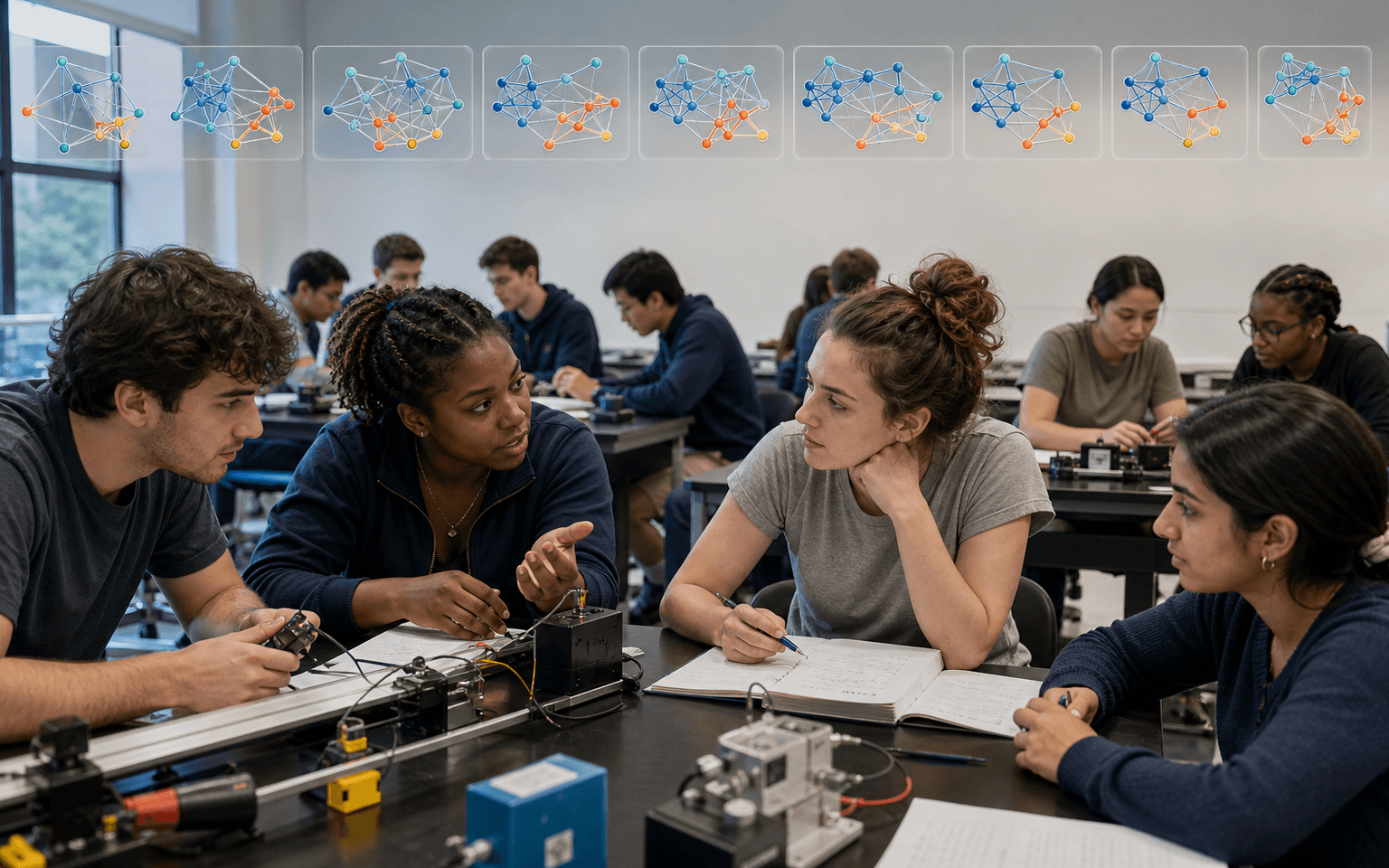
Tracking collaboration structure across a two-course introductory physics sequence
Steven Wolf, Timothy Sault, Tyme Suda, Adrienne Traxler
Applied Network Science
Network design
Nodes
students enrolled across the fall and spring courses of one introductory physics sequence
Ties
directed self-reports of classmates with whom each student had meaningfully collaborated during the current exam interval
Methods
The team compared repeated global and node metrics, used CONCOR to identify structurally equivalent blocks, applied edge-betweenness community detection, and tracked persistence and change across eight survey waves.
Source: Applied Network Science
Reviewed summary
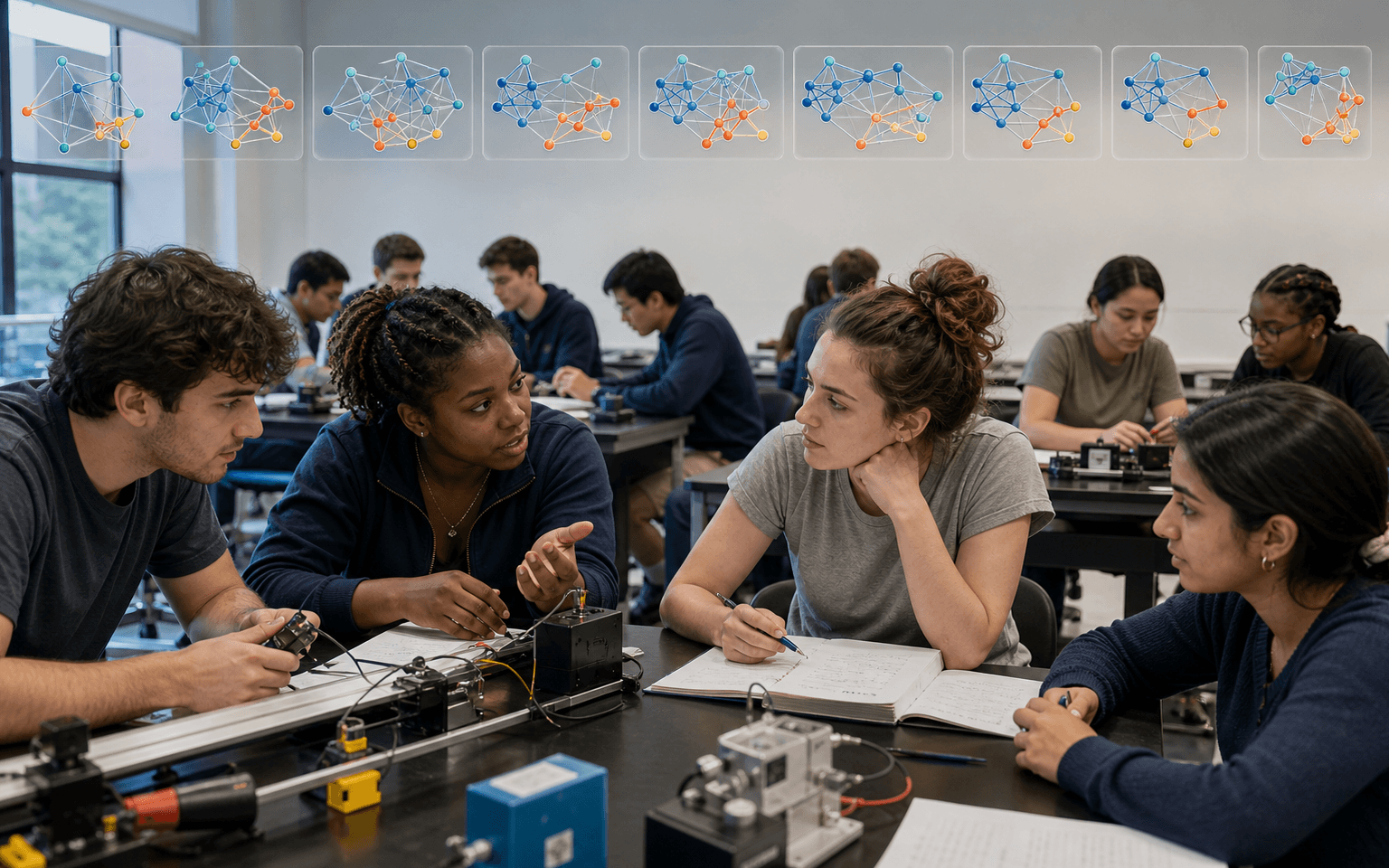
Students in a two-course introductory physics sequence named collaborators at four exams per semester. Global and node measures, structural-equivalence blocks, and communities showed an early period of relationship exploration, later stabilization, and substantial carryover of ties into the second term. The paper shows why longitudinal classroom analysis should track both specific ties and role-equivalent structures, because one can change while the other remains stable.
Fall networks first showed a period of trying out partners and then stabilized; about half the class carried relationships into spring, while the first-to-second exam transition disrupted conventional metrics even when structural blocks remained recognizable. Evidence came from one physics sequence and self-reported collaboration windows. Exam timing, enrollment changes, missing nominations, and the selected block and community algorithms influence the pattern, so the study describes evolution without identifying an instructional cause.
SNA
How SNA was used
The study defined students enrolled across the fall and spring courses of one introductory physics sequence as nodes and directed self-reports of classmates with whom each student had meaningfully collaborated during the current exam interval as ties. The team compared repeated global and node metrics, used CONCOR to identify structurally equivalent blocks, applied edge-betweenness community detection, and tracked persistence and change across eight survey waves.
Source
Applied Network Science, 7, Article 24
DOI: 10.1007/s41109-022-00465-z