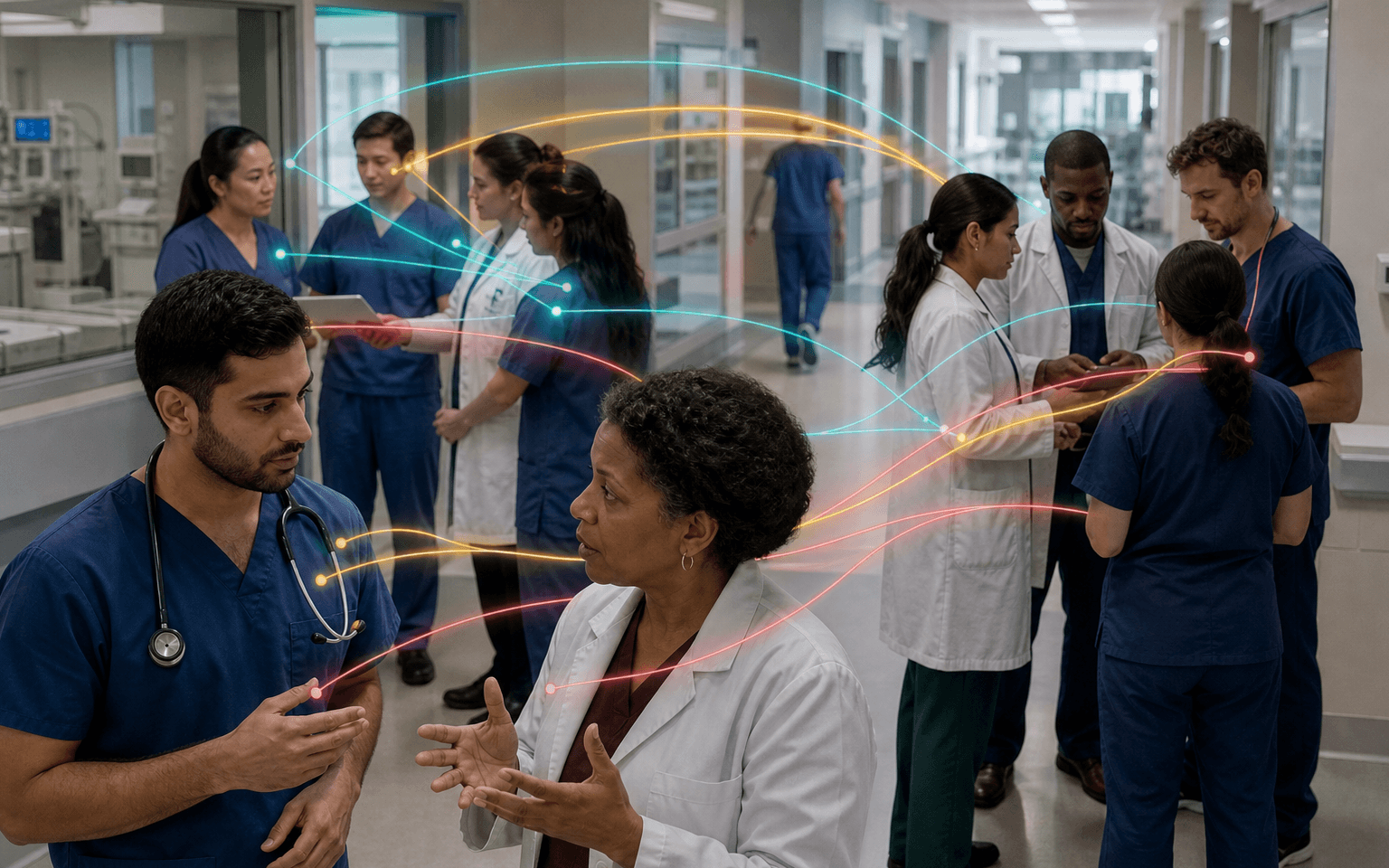
Online problem-based learning interaction networks and medical student performance
Mohammed Saqr, Hani Alamro
BMC Medical Education
Network design
Nodes
135 medical students and 15 tutors assigned to 15 online PBL groups
Ties
directed learning-platform interactions among students and tutors, including posted replies within each problem discussion
Methods
The authors constructed directed group networks, calculated centrality and cohesion measures, visualized participation patterns, and used Spearman correlations to compare interaction positions with academic performance.
Source: BMC Medical Education
Reviewed summary

A study of 135 students and 15 tutors across 15 problem-based learning groups analyzed 2,620 online interactions, 89 percent of them student-to-student. Out-degree and tutor interaction had small positive correlations with performance, showing useful relational signals without supporting causal ranking. The results support examining who exchanges help with whom inside PBL groups rather than reducing collaboration to total logins, while keeping intervention decisions proportional to modest effects.
Student-to-student exchanges formed 89 percent of 2,620 interactions; out-degree correlated with performance at about 0.27 and tutor interaction at about 0.22, both small observational associations. This exploratory single-course case used platform activity as a proxy for educational exchange and did not model content quality, prior achievement, nested dependence, or unobserved offline interaction comprehensively. Its small correlations do not justify causal claims or automated high-stakes decisions.
SNA
How SNA was used
The study defined 135 medical students and 15 tutors assigned to 15 online PBL groups as nodes and directed learning-platform interactions among students and tutors, including posted replies within each problem discussion as ties. The authors constructed directed group networks, calculated centrality and cohesion measures, visualized participation patterns, and used Spearman correlations to compare interaction positions with academic performance.
Source
BMC Medical Education, 19, Article 160
DOI: 10.1186/s12909-019-1599-6