Inferring daily college peer networks from campus behavioral data
Yuan Zhou, Xiao Meng, Jiayin Wang, Xu Mo, Sa Jiang, Chengjun Dai, Mengting Liu
Sustainability
Network design
Nodes
4,738 undergraduates in one entry cohort represented across repeated days of campus activity
Ties
inferred daily peer links based on temporally and spatially proximate campus behaviors such as class attendance, eating, residence, and bathing
Methods
The study constructed day-level behavioral networks, detected communities with Louvain methods, summarized density and clustering, tracked community composition over time, and tested associations between peer features and scholarship achievement.
Source: Sustainability
Reviewed summary
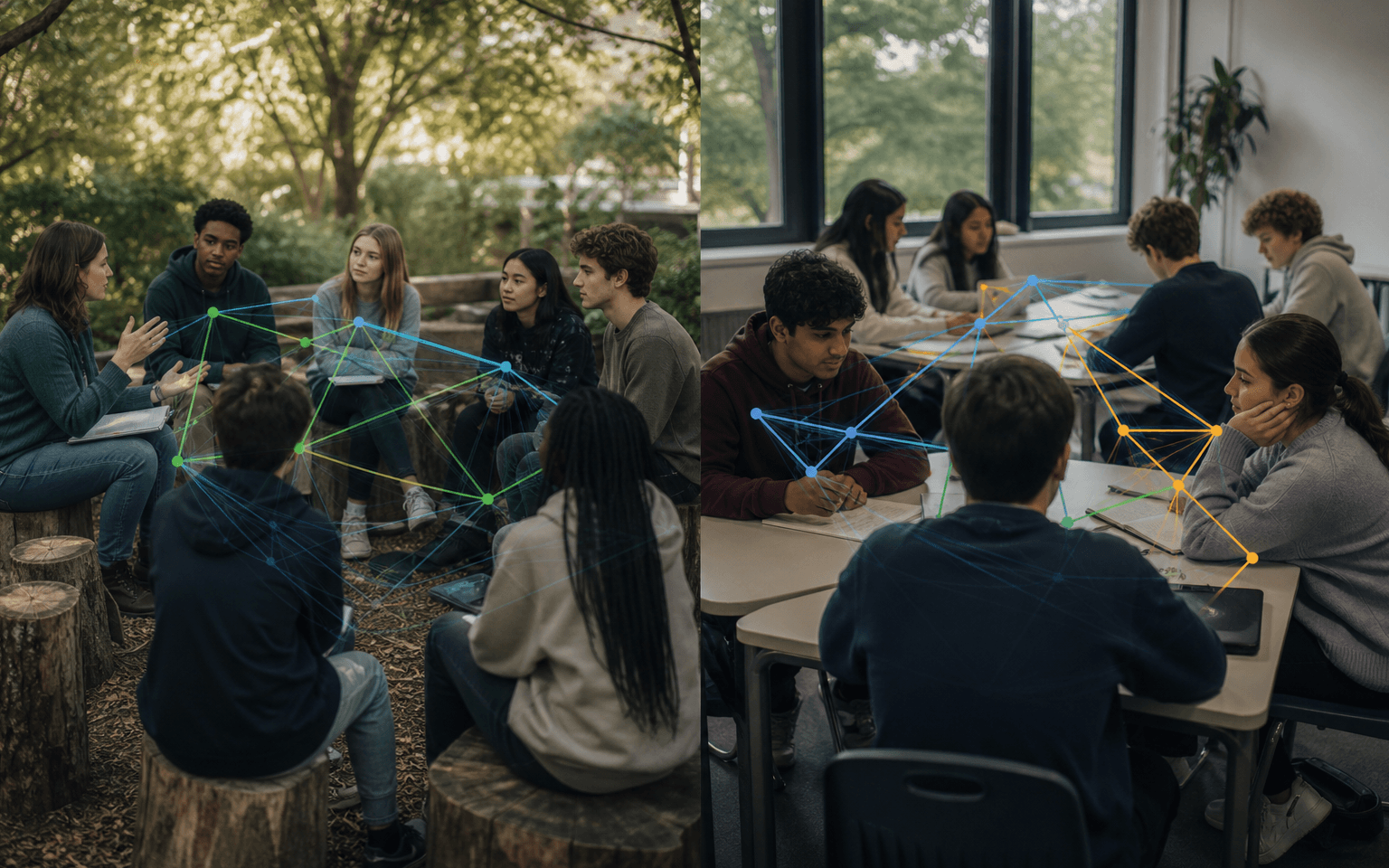
Behavioral records for 4,738 undergraduates entering in 2018 were used to infer daily peer networks from co-occurring attendance, dining, residence, and bathing activity. Communities shifted from residence-centered to classmate-centered patterns, while peer achievement and scholarship status were associated. The large longitudinal trace dataset shows how campus routines can reveal changing opportunity structures, while also making explicit the need to validate what a digital co-occurrence tie actually represents.
Early communities were more residence-centered and later became more classmate-centered; geography and living areas shaped ties, and high-scholarship students were more likely to connect with similarly awarded peers. Co-location and similar routines are proxies, not confirmed friendship, advice, or collaboration. One university cohort, institutional systems, privacy filtering, unmeasured prior selection, and many daily observations limit generalization and causal claims about peers or scholarships.
SNA
How SNA was used
The study defined 4,738 undergraduates in one entry cohort represented across repeated days of campus activity as nodes and inferred daily peer links based on temporally and spatially proximate campus behaviors such as class attendance, eating, residence, and bathing as ties. The study constructed day-level behavioral networks, detected communities with Louvain methods, summarized density and clustering, tracked community composition over time, and tested associations between peer features and scholarship achievement.
Source
Sustainability, 15(22), Article 15762
DOI: 10.3390/su152215762