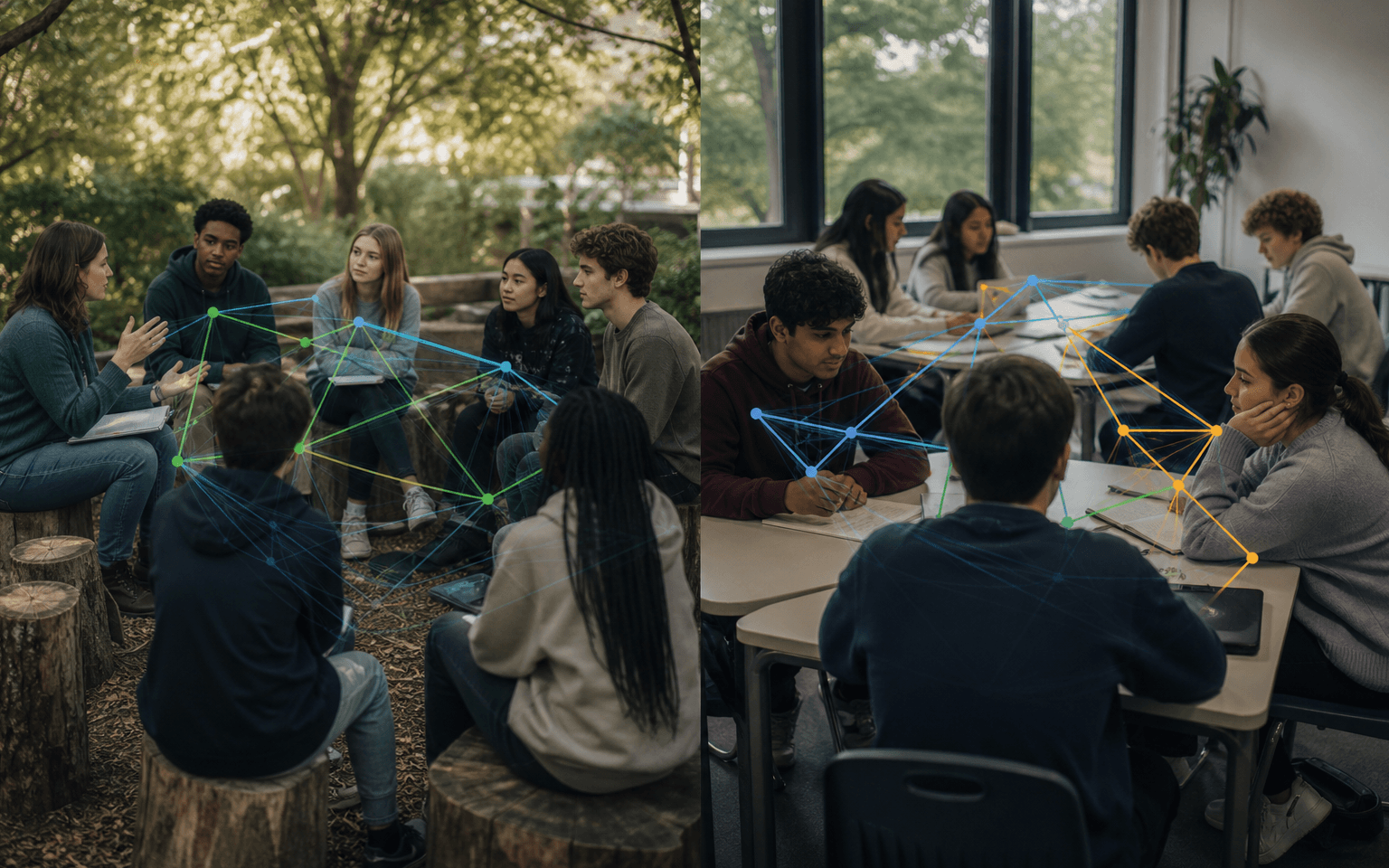
Education outside the classroom and the evolution of peer interaction networks
Jan Ellinger, Filip Mess, Joachim Bachner, Jakob von Au, Christoph Mall
Frontiers in Psychology
Network design
Nodes
students in one education-outside-the-classroom class and one comparison class
Ties
reported lesson and break-time interactions, relatedness, and friendship links observed across the study waves
Methods
The authors used stochastic actor-oriented models for network evolution and co-evolution and ERGMs for selected cross-sectional structures, testing reciprocity, transitivity, gender and residence homophily, and grouping patterns.
Source: Frontiers in Psychology
Reviewed summary
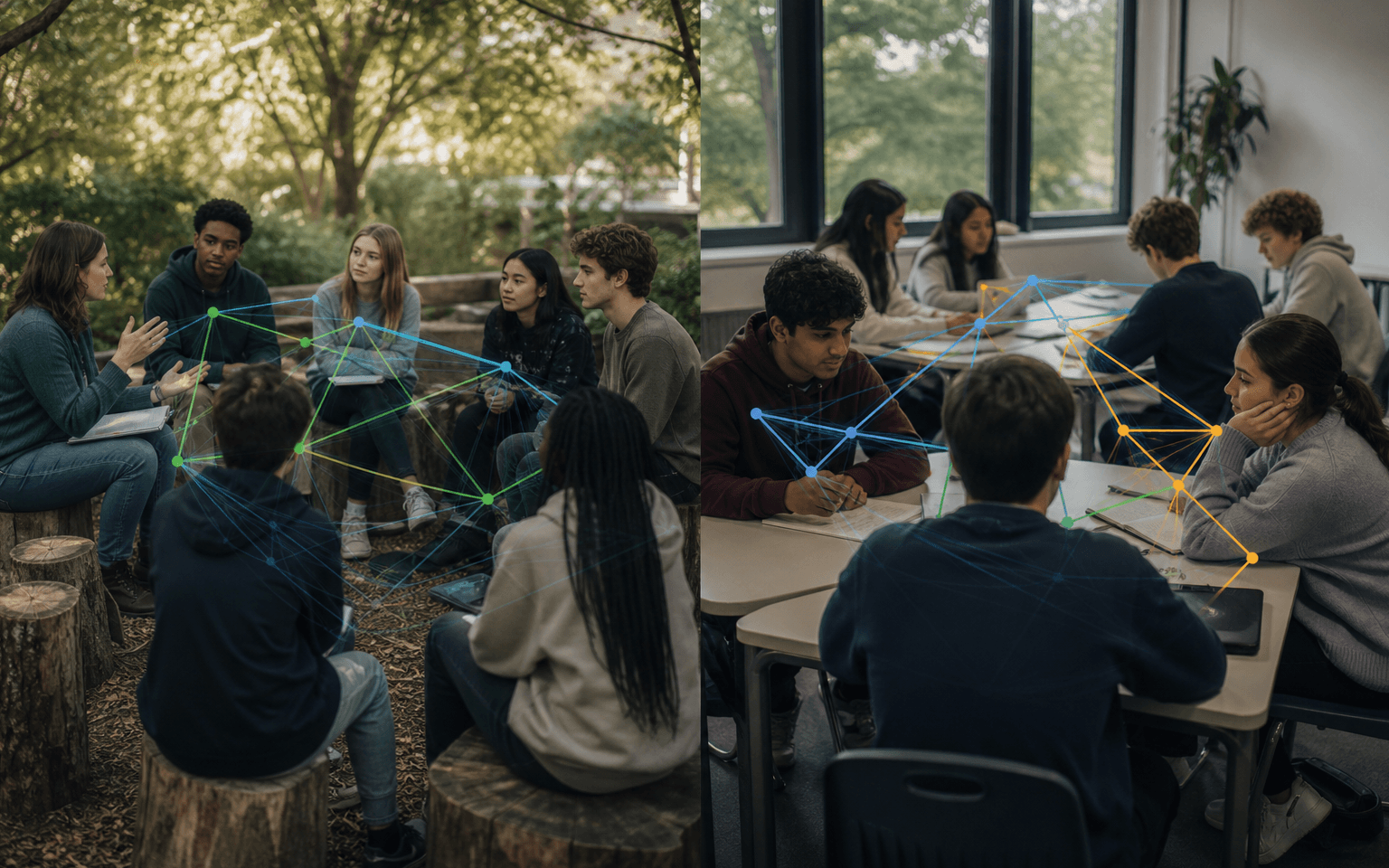
One class using regular education outside the classroom with 24 students was compared with a 26-student class. Longitudinal interaction, relatedness, and friendship networks were examined with stochastic actor-oriented and exponential random graph models; changes were inconsistent and strong gender homophily remained. The results temper assumptions that changing the learning location automatically integrates peers and demonstrate how longitudinal models can distinguish selection, structure, and changing relationships.
The study did not find consistent co-evolution between the focal networks or uniform interaction gains; both classes showed grouping, and pronounced gender homophily contributed to fragmentation in the outdoor-learning class. Only two small, non-randomly assigned classes were studied, so classroom history, teachers, residence, gender composition, measurement waves, and model specification can drive differences. Null or inconsistent parameters are not evidence that outdoor education has no other benefits.
SNA
How SNA was used
The study defined students in one education-outside-the-classroom class and one comparison class as nodes and reported lesson and break-time interactions, relatedness, and friendship links observed across the study waves as ties. The authors used stochastic actor-oriented models for network evolution and co-evolution and ERGMs for selected cross-sectional structures, testing reciprocity, transitivity, gender and residence homophily, and grouping patterns.
Source
Frontiers in Psychology, 14, Article 1031693
DOI: 10.3389/fpsyg.2023.1031693