Online collaborative learning changed medical students' social networks without lowering grades
Yan Zhou, Xiaoming Xu, Johanna Schönrock-Adema, Jasperina Brouwer, Nicolaas A. Bos, Agnes D. Diemers
Frontiers in Medicine
Network design
Nodes
medical students in a pre-pandemic cohort and a separate cohort studying during pandemic-era online collaboration
Ties
up to 25 directed nominations per student across study support, collaboration, friendship, information sharing, and learned-from networks
Methods
Researchers constructed five networks for each cohort, compared structural and subgroup patterns, used Kruskal-Wallis tests for academic performance, and interpreted open-ended responses about students' online learning experiences.
Source: Frontiers in Medicine
Reviewed summary

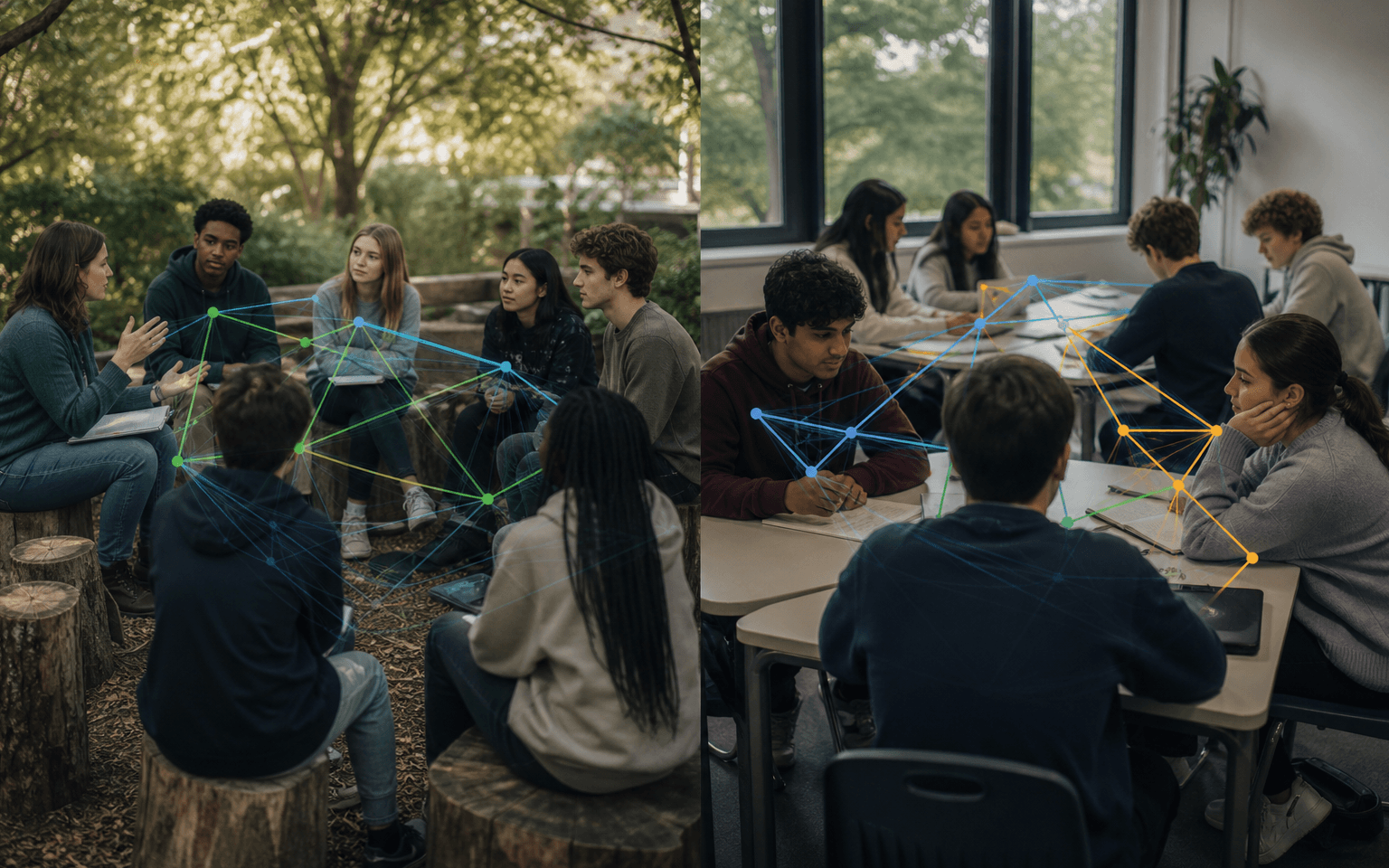
The study compared 102 pre-pandemic and 167 pandemic-era medical students across five out-of-class networks: study support, collaboration, friendship, information sharing, and learning from others. Networks were generally smaller during online collaborative learning, but academic performance did not decline. The paper separates several kinds of social access and cautions institutions to monitor relational opportunity during online learning even when aggregate grades appear stable.
Students in the pandemic-era cohort reported smaller informal networks and some subgroup differences, yet their grades were not lower, showing that network contraction and academic performance did not move in lockstep. The cohorts contained different students and were observed cross-sectionally, so pandemic conditions, curriculum, assessment, composition, and self-report can confound the comparison. Up-to-25 nominations and out-of-class reports miss some interaction, and stable grades do not prove equivalent learning.
SNA
How SNA was used
The study defined medical students in a pre-pandemic cohort and a separate cohort studying during pandemic-era online collaboration as nodes and up to 25 directed nominations per student across study support, collaboration, friendship, information sharing, and learned-from networks as ties. Researchers constructed five networks for each cohort, compared structural and subgroup patterns, used Kruskal-Wallis tests for academic performance, and interpreted open-ended responses about students' online learning experiences.
Source
Frontiers in Medicine, 10, Article 1242638
DOI: 10.3389/fmed.2023.1242638